
01 / Keynote spotlights
Three markets. Different paths. A shared musical future.
Jaco Zhang, Chris Wares and Bernie Cho examined how China, the United States and Korea discover music, develop artists and build audiences across borders.
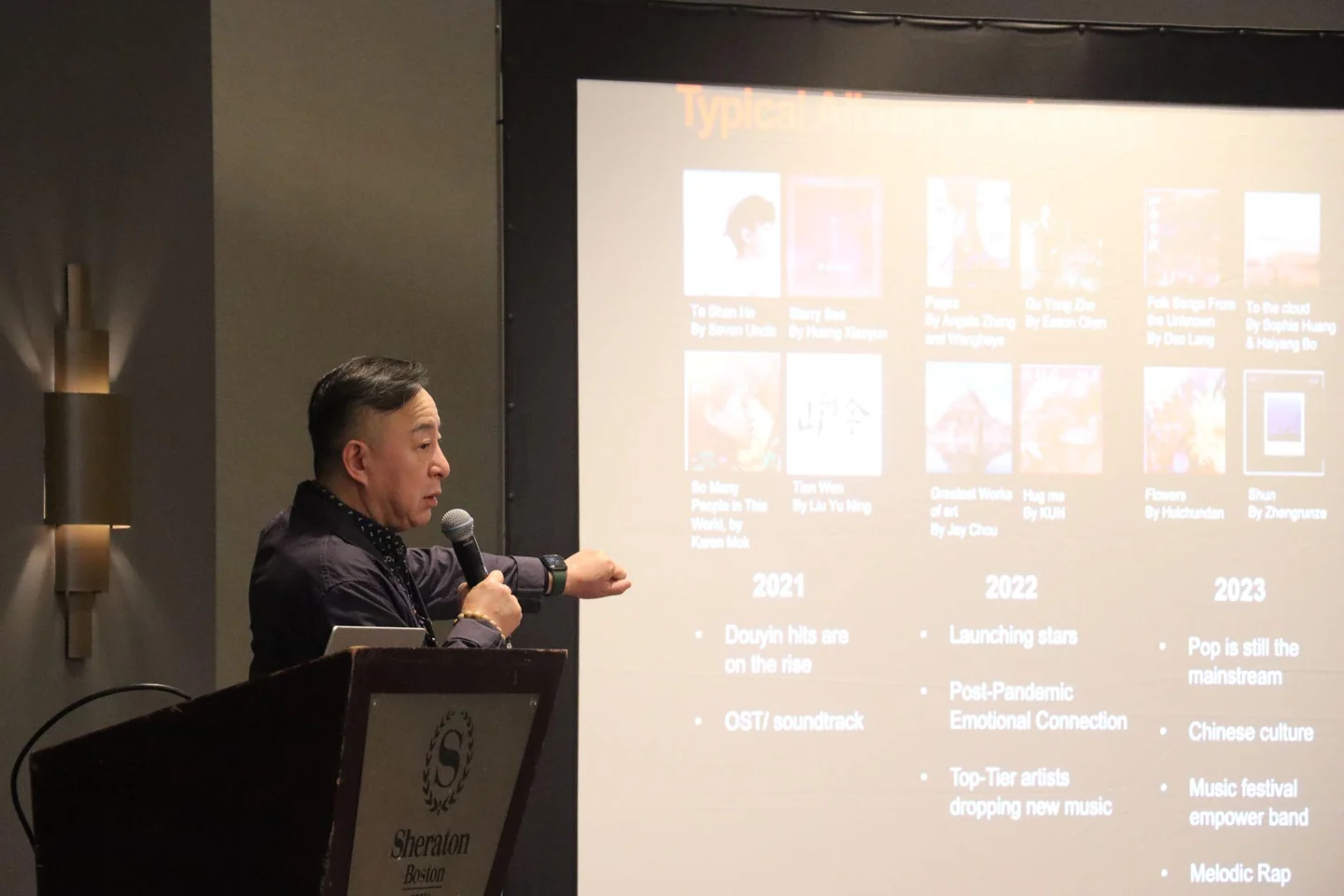
A conversation across three music industries
The second Asian Music Industry Festival brought musicians and industry professionals to Boston on November 15–16, 2025. Presented by the Global Center of Arts and Culture, the festival paired performances with discussions about the structures that shape a musical career. Its keynote spotlights invited three experienced practitioners to explain how those structures differed across China, the United States and Korea.
Jaco Zhang, Production Director at Sony Music China, led the China spotlight. Chris Wares, Assistant Chair of Music Business/Management at Berklee College of Music, discussed the United States. Bernie Cho of DFSB Kollective explored Korea. Together, their talks connected questions of taste and cultural identity with practical decisions about distribution, promotion and artist development.
China: scale, originality and the pressure to repeat a hit
Zhang began with the changing composition of the Chinese music market. He identified livestreaming and paid consumption as important areas of activity, alongside the continuing strength of Chinese-language pop, screen soundtracks and music drawing on Chinese cultural traditions. The Chinese session report recorded figures of 25–35 percent for paying users, and shares of 62 percent for Chinese-language pop, 16 percent for film and television songs, and 18.88 percent for guofeng music. These were figures presented in the 2025 discussion, rather than a newly commissioned market survey.
Artificial intelligence and collaboration across media were central to his outlook. He pointed to connections between music and cultural institutions, games, virtual worlds and digital collectibles. Such collaborations could open new routes for music, but the same technologies also created pressure toward imitation: once algorithms revealed the characteristics of a popular song, creators could reproduce those characteristics in pursuit of a quick return.
Drawing on more than four decades in the industry, Zhang described R&B as an area of rapid growth while noting that pop remained firmly established. His larger argument was about patience. Original work needed time to develop and find its audience. A lasting classic and a sudden commercial hit represented different forms of success; neither could be understood solely through a hierarchy of taste.
The United States: distribution, independence and a fragmented industry
Wares approached the business through its markets, release channels and organizational structure. He contrasted Japan’s continuing importance in physical CD sales with the prominence of streaming in the United States and many Asian markets. Despite the proliferation of digital discovery tools, he stressed the enduring value of recommendations passed from person to person. Hip-hop and country were among the genres he discussed in relation to American listening habits.
He also unpacked the difference between a music group and its individual businesses. Universal, Sony and Warner operated across recording, publishing, distribution and other activities; understanding which part of an organization performed which function was essential for an artist evaluating a partnership.
Independent distribution offered another route. Wares cited platforms including CD Baby, DistroKid and Symphonic as examples of services that had made international release more accessible. The report referenced an approximately US$50 entry point to illustrate this shift; it was an example from the talk, not a current price or a uniform fee across those services. The important change was that artists could reach listeners without first securing a traditional major-label agreement.
Comparing business structures, he described a more separated chain of functions in the United States and greater concentration of activities within a single company in Korea. He also considered virtual concerts, digital music-related products and blockchain-based ownership records as possible directions for the industry, including their potential to address fragmented royalty information. These were possibilities discussed at the festival, not predictions presented as settled outcomes.
Korea: making discovery global and fandom personal
Cho examined the deliberate work behind K-pop’s international reach. Bilingual English and Korean titles and lyrics made music easier for listeners outside Korea to find. Relationships with social platforms helped labels reach particular audiences, while multilingual artists and international partnerships extended those connections beyond a single release.
He discussed collaborations such as HYBE with Universal Music Group and JYP with Live Nation as examples of cross-border infrastructure. Multilingual communication—often involving Korean, English, Japanese or Thai—was another part of the process. Global visibility depended on both an artist’s public identity and the network supporting it.
Fan communities were the fourth pillar of his account. The report cited a worldwide audience exceeding 225 million across 112 markets and more than 1,700 international fan clubs. Cho’s emphasis was less on the totals than on the continuing relationship behind them: regular updates about performances, endorsements and new music helped fans feel involved, sustaining attention between major releases.
From distant markets to practical choices
Audience members took notes, photographed presentation material and brought their own questions into the discussion. The exchange turned broad labels such as ‘the Chinese market’ or ‘the Korean industry’ into more specific systems of people, decisions and opportunities. For emerging musicians, the value lay in seeing both the differences between markets and the choices that could connect them.